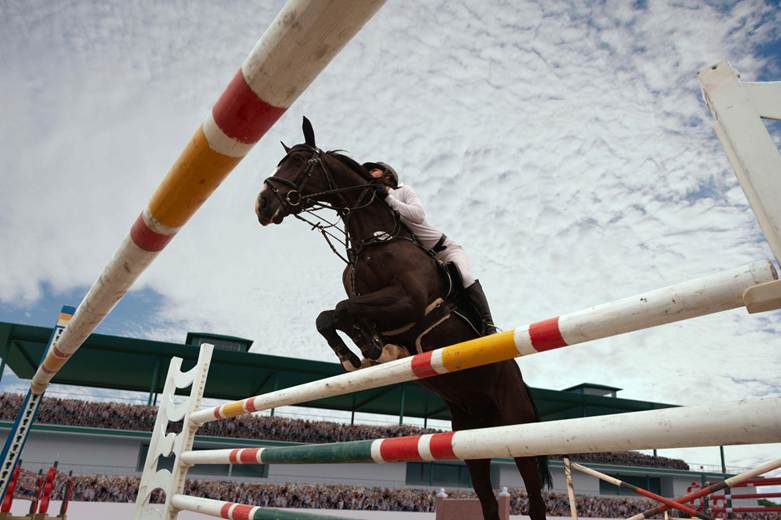
Much of a show jumper’s education happens far from the competition ring, in quiet sessions over carefully spaced poles and small fences. In programs shaped by trainers such as Freddie Vasquez Jr., this gymnastic work is often treated as one of the most efficient ways to develop a horse that jumps with skill and confidence.
Grid work rarely looks impressive from the rail. The fences are low, the exercises are repetitive, and nobody is racing the clock. Yet the lessons learned in these sessions often decide how a horse handles a demanding course later.
What Is Grid Work?
A grid, also called a gymnastic, is a line of small fences set at fixed distances so the horse meets each one in a predictable rhythm. Bounces, where the horse lands and takes off again without a stride in between, are commonly set around 9 to 11 feet apart. One-stride combinations typically fall somewhere between 18 and 24 feet, depending on the height of the fences and the goal of the exercise.
Because the distances are set in advance, the grid itself does much of the teaching. The horse learns to organize its body to meet each fence correctly, while the rider’s job shifts from finding distances to staying balanced and out of the way.
Why Grids Teach Better Than Endless Courses
Grids allow a horse to learn through repetition without the pressure of a full course. Jumping complete courses at home can teach a horse to rush, to depend on the rider for every decision, or to lose confidence after a few awkward distances. A well-built grid removes most of that guesswork.
Each pass through the line asks the same question in the same way, which gives the horse a chance to figure out the answer for itself. Over time, horses that do regular grid work often become more careful, more adjustable and better at correcting small mistakes on their own. Those are precisely the qualities that matter when a course designer presents a tricky combination.
What Grids Develop in the Horse
The benefits of gymnastic work show up throughout a horse’s jumping:
- Quicker footwork, especially from bounces that ask for fast, athletic responses
- Better adjustability, as shorter and longer distances teach the horse to compress or lengthen its stride
- A rounder jumping arc, encouraged by ground lines and well-placed poles
- Straightness, since a line of fences rewards a horse that stays centered
- Confidence, built through success at heights well within the horse’s ability
Because the fences stay low, horses gain these skills without the physical strain of jumping big fences over and over.
What Grids Teach the Rider
Grid work trains riders as much as horses, mainly by teaching them to trust the exercise and stay still. With the distances already set, a rider can focus on position, balance and steady contact instead of searching for a spot to take off.
Many riders discover that the horse jumps better when they interfere less. That lesson carries straight into the competition ring, where a quiet, secure rider gives the horse the freedom to use itself. Grids also sharpen a rider’s feel for rhythm, which is the foundation of nearly every good round.
Designing Grids With a Clear Purpose
The most effective grids start simple and build gradually, adding one new challenge at a time. A session might begin with trot poles and a single small fence, then add elements one by one as the horse settles into the exercise.
Distances can be adjusted to suit the goal. A slightly shorter distance makes it easier for a horse to rock back and use its hind end, while a slightly longer one encourages a horse to move forward and open its stride. Heights rarely need to be high, because the purpose is technique and quickness rather than raw power.
Variety keeps the work productive. Changing the grid from week to week prevents horses from memorizing the exercise and keeps them thinking. Short sessions with plenty of breaks usually produce better results than long, repetitive ones.
Common Mistakes to Avoid
Grids are powerful tools, but they can backfire when misused. The most frequent problems include:
- Raising the fences too quickly, before the horse is confident with the exercise
- Building lines that are too long or complicated for the horse’s experience
- Drilling the same grid until the horse becomes tired
- Riders steering or pushing through every element instead of letting the grid work
Each of these turns a teaching exercise into a test, which defeats the purpose. The goal is always a horse that leaves the session more confident than it started.
Small Fences, Big Lessons
Grid work may be one of the least glamorous parts of show jumping, but it quietly shapes nearly everything that happens in competition. Horses become sharper and more careful over fences, and riders develop a lighter, steadier feel in the saddle.
When a horse handles a difficult combination with ease, the credit often belongs to hours of patient gymnastic work at home. The biggest rounds tend to be built over the smallest fences.