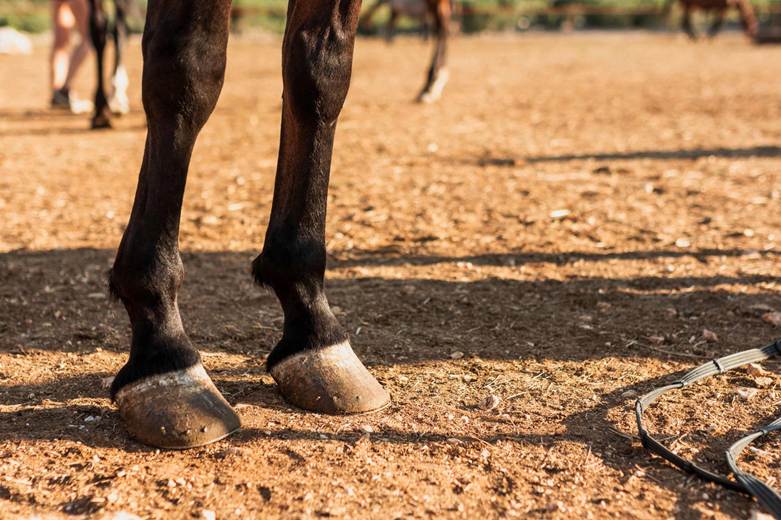
Footing is one of the least visible factors in show jumping performance, a point Freddie Vasquez Jr. has seen play out on surfaces ranging from Florida’s winter circuit to Pan American competition. The ground beneath a horse shapes every stride, takeoff, and landing, often in ways that only become obvious when something goes wrong.
Spectators notice the fences, the turns and the clock. Far fewer think about the surface itself, yet it influences soundness and confidence and results in nearly every class.
What Good Footing Does for a Horse
Good footing lets a horse push off, land, and turn securely while limiting strain on joints, tendons, and ligaments. On good ground, a horse moves more freely and jumps with more power.
Poor footing has the opposite effect. Hard ground sends more shock up the legs with every landing. Deep ground makes each stride harder work and can strain soft tissue. Slippery ground forces a horse to shorten its stride to stay on its feet, which costs both power and accuracy.
The effects build quietly. A single session on poor ground rarely causes a problem, but months of training on it can wear on a horse’s body long before any lameness appears.
The Five Qualities Experts Look For
Surface specialists generally describe footing through five properties, and an international group of equine surface experts has agreed on them as a basis for common standards:
- Impact Firmness: How hard the surface feels when the hoof first strikes it
- Cushioning: How well the surface absorbs the load as the leg takes weight
- Responsiveness: How much energy the surface returns as the horse pushes off
- Grip: How well the hoof holds without slipping during turns and takeoffs
- Uniformity: How consistent all of these qualities are across the whole arena
No single setting suits every horse or every use, but a surface that balances all five tends to support both performance and soundness.
Why Consistency Is the Hidden Priority
Uniformity matters because a horse adjusts its stride to the surface beneath it, so any sudden change catches it off guard. Trouble begins when the footing changes from one part of the arena to another, such as a deep patch near the gate or a firmer track along the rail.
A horse that meets an unexpected change mid-stride has very little time to adapt. That sudden shift is where many slips and awkward landings begin. A uniform surface, even one that is not perfect, is often easier on a horse than one that is excellent in places and poor in others.
Grass, Sand and Everything in Between
Different surfaces bring different challenges. Many modern arenas use sand blended with fibers or textiles to improve grip and stability, while grass fields offer a natural feel prized for derbies and certain grand prix classes.
Grass can ride beautifully when well maintained, but it changes with rain, heat and heavy use more than most engineered surfaces do. Sand-based arenas offer more control, though they still depend on careful watering and grooming to stay consistent throughout a long day of classes.
Weather affects every option. A surface that rides perfectly in the morning can become firmer as it dries or slicker after a passing shower, which is why experienced riders keep evaluating the ground as conditions change.
Indoor arenas add another layer. Sheltered from sun and rain, indoor footing tends to stay more predictable, yet it can dry out and turn hard or dusty without regular watering. Over time, that dust can also irritate a horse’s airways.
How Riders Adapt to the Ground
Watching how the horses that go first in a class move, noticing where they slip or struggle, and feeling the surface during the warm-up all shape the decisions that follow.
Adjustments can be small but meaningful. Studs or caulks can add grip on grass or firmer surfaces. A warm-up might be shortened on deep ground to save the horse’s energy for the class itself. Tight turns that work on grippy footing may need a wider approach on a looser surface.
Over a long season, these choices add up. Protecting a horse from unnecessary strain on difficult footing is one of the quiet ways good horsemanship extends a competitive career.
Maintenance Makes the Surface
Experts commonly point to three things that determine how well an arena performs: the right materials and design, correct installation, and ongoing maintenance. The first two happen once. The third happens every day.
Regular harrowing, careful watering, and attention to drainage keep a surface level and uniform. Without that care, even an expensive arena gradually develops ruts, hard spots, and deep edges. Home arenas deserve the same attention as competition footing, since horses spend far more time training at home than showing.
The Ground Beneath Every Result
Footing rarely makes headlines, yet it sits beneath every clear round and every long, healthy career. Horses that work on good ground jump more freely, recover more easily, and stay in the sport longer.
For riders and owners, paying attention to the surface is less about technical detail and more about respect for the horse. The best performances start from the ground up.